How much custom software development costs in India in 2026
Rough price bands for websites, internal tools, apps and AI features, what pushes a quote up, and how to read one line by line before you sign.
NectArray team · 23 September 2026 · 4 min read
"How much will it cost?" is the first question every client asks, and the honest answer from any software company is "it depends". That is true and not very useful. This article gives rough price bands for the most common kinds of custom software in India in 2026, explains what moves a quote up or down, and shows how to read a quote before you sign it.
The numbers are broad ranges for the Indian market, for work done by experienced teams. Freelancers can come in lower and large agencies higher. Treat them as a way to sense-check a quote, not as a price list.
Rough price bands
| What you are building | Typical time | Rough cost |
|---|---|---|
| A business or portfolio website with a CMS | 2 to 4 weeks | ₹40,000 to ₹1.5 lakh |
| An e-commerce store with payments and shipping | 4 to 8 weeks | ₹1.5 to 5 lakh |
| An internal tool or dashboard, such as orders, stock or reports | 4 to 10 weeks | ₹2 to 8 lakh |
| A customer web app with logins, roles and payments | 2 to 5 months | ₹6 to 25 lakh |
| A mobile app for Android and iOS alongside a web back end | 3 to 6 months | ₹8 to 30 lakh |
| Adding an AI feature, such as document Q&A or an agent, to existing software | 3 to 8 weeks | ₹1.5 to 10 lakh |
Running costs come on top: hosting, domains, email, third-party services and maintenance. For a small business app, hosting is often ₹2,000 to ₹15,000 a month. Maintenance contracts commonly run at 15 to 20 percent of the build cost per year.
What pushes the price up
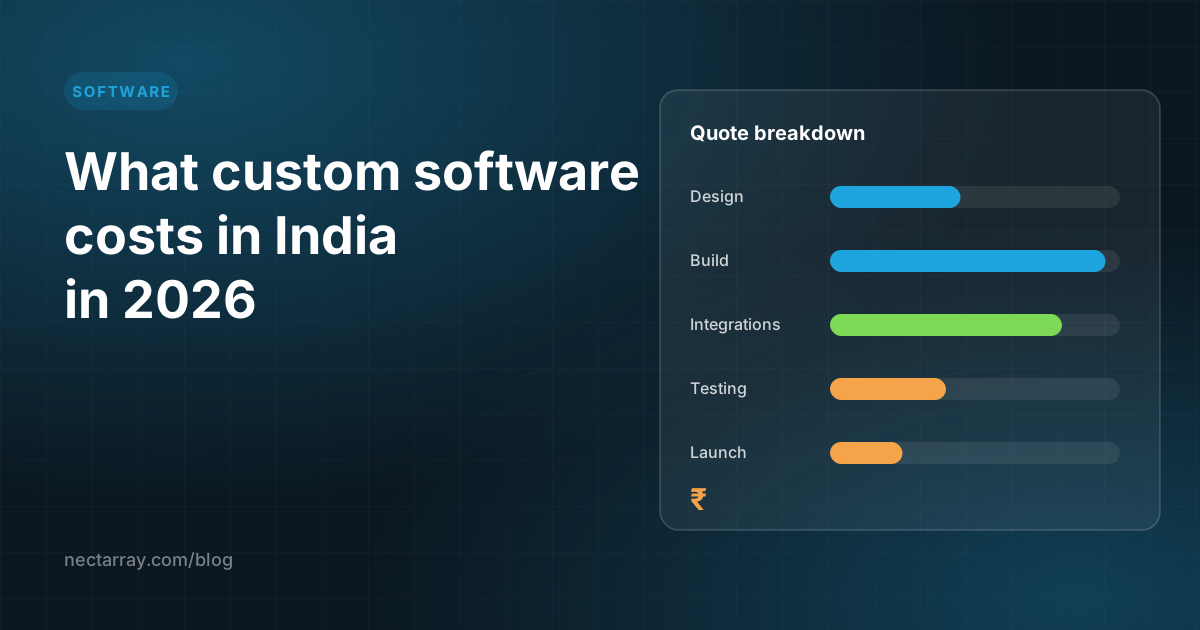
Most of the cost in custom software goes into what the screens connect to and the unusual cases they have to handle.
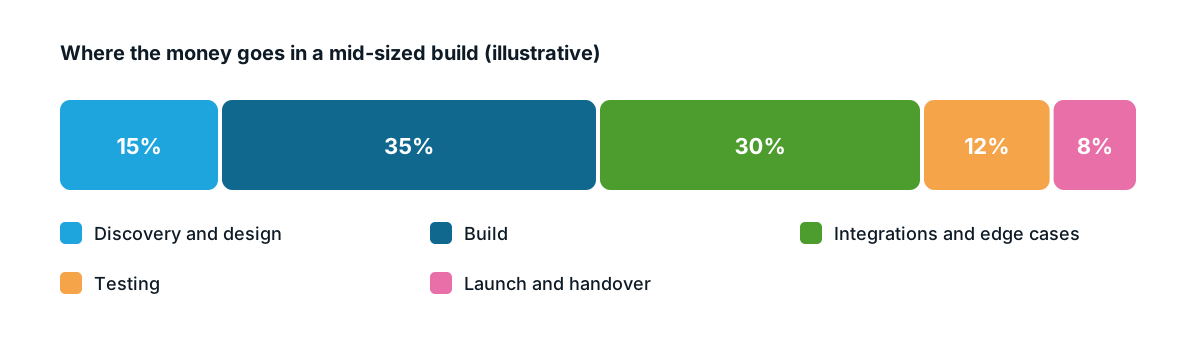 Where the money goes in a typical mid-sized build. Integrations and edge cases are usually larger than clients expect.
The main drivers:
- Integrations. Every outside system, whether Razorpay, Shiprocket, Tally, a WhatsApp API or your old ERP, adds work to connect, test and keep working when the other side changes.
- User roles. An app with one kind of user is much simpler than one with customers, staff, managers and admins who each see different things.
- Offline or real-time needs. Live updates, offline mode on mobile and syncing all add a lot of engineering.
- Data migration. Moving years of records out of spreadsheets or an old system is slow, careful work that is often left out of the first quote.
- Compliance. Payments, health data and anything regulated need audit logs, access control and review.
- Unclear scope. The single biggest cost driver is a requirement that changes halfway through the build.
What brings it down
- Start with the smallest version that someone would actually use, and add the rest after launch.
- Use off-the-shelf pieces for anything that is not special to your business, such as logins, payments, email and admin panels.
- Write down your process before the first meeting. Half a page on who does what, in what order, saves days of discovery.
- Decide who on your side answers questions, and make sure they answer within a day. Waiting for decisions is expensive.
How to read a quote
A good quote is broken down so you can see where the money goes. Check for:
- A list of features, each with an estimate. A single total with no breakdown makes it impossible to cut scope sensibly.
- What is excluded. Hosting, content, data migration, app store fees and third-party subscriptions are the usual gaps.
- The payment schedule. Milestone payments tied to working software you can try are safer than large advances.
- What happens to change requests, and at what rate they are billed.
- Who owns the code, and whether you get the repository and credentials at the end.
- The warranty period for bugs after launch, and what support costs after that.
If two quotes differ by a factor of three, it is usually because they have assumed different scopes. Put the same written list of features in front of both companies and ask them to quote line by line.
Fixed price or time and materials
A fixed price suits small, well-defined projects: a website, a store, a single internal tool. You know the cost upfront, and the company carries the risk of underestimating.
Time and materials, where you pay for the hours worked, suits larger products where the details will change as you learn from users. It is cheaper overall when scope moves, but it needs you to track progress every week.
Many projects mix the two: a fixed price for a first version, then monthly time and materials for everything after launch.
A realistic budget
For a small business building its first piece of custom software, a sensible plan is a first version in the ₹2 to 6 lakh range, launched in six to ten weeks, plus a monthly budget for hosting and small improvements. Build something narrow that people use every day, then spend the next budget on what they ask for.
If you send us a short description of what you want to build, we will reply with a breakdown you can compare against any other quote you have.